

The romaine lettuce a shopper selects from a grocery display may look freshly stocked, but it was likely harvested days earlier, cooled within hours of cutting, loaded onto a refrigerated truck in California’s Salinas Valley, and routed through at least one regional distribution center before reaching that shelf.
“Fresh” as a marketing impression and “fresh” as a biological state are not the same measurement, and the gap between them is structural, not accidental. From the moment a farmer cuts or picks a crop, a biological countdown begins that no supply chain can fully stop, only slow.
Understanding that countdown through harvest biology, cold-chain logistics, laboratory safety monitoring, traceability systems, and the sensory tools available in a kitchen is what this article traces. The goal is informed confidence, not alarm.
The Moment It Leaves the Ground, the Countdown Begins
Harvested produce is still living tissue, and after separation from its root or stem, it continues to respire by consuming its own stored sugars and starches for energy. Senescence, the biological aging process, advances without any mechanism to replenish what is spent, which means the crop is no longer growing. It is slowly dying, and every hour at suboptimal temperatures accelerates that decline.
The rate of decline varies sharply by commodity, since leafy greens such as romaine and spinach have notoriously short post-harvest windows. For crisphead lettuce, a storage life of about 14 days can be expected at 5°C (41°F), provided there is no ethylene in the environment. Dropping that temperature closer to freezing changes the timeline significantly.
The optimal storage temperature for crisphead lettuce is 0°C (32°F), where a postharvest life of 21 to 28 days becomes possible depending on the cultivar. Apples occupy the opposite end of the spectrum, as some varieties, such as Fuji, can hold for up to nine months in controlled-atmosphere storage because reduced oxygen levels and elevated carbon dioxide slow respiration dramatically. A consumer buying Fuji apples in April might be eating fruit harvested the previous October.
Tomatoes present an entirely different pattern. Commercial growers harvest them at the mature-green stage before full ripening because vine-ripened fruit cannot survive long transit. The gassing and distribution-center ripening that commercially grown tomatoes undergo produces color and softness.
Three separate dates govern every piece of produce on a retail shelf. The harvest date, the sell-by date, and the date a consumer actually eats it rarely align. The UC Davis Postharvest Technology Center maintains publicly accessible commodity-specific shelf-life data covering hundreds of crops, making it a reliable reference for understanding these storage windows by variety and handling method.
The Lab’s Role in Early Safety Monitoring
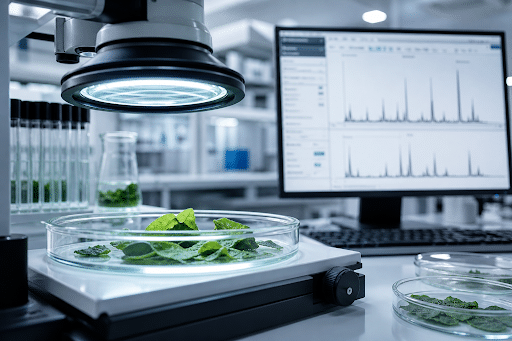
Regulatory agencies run monitoring programs that test fresh produce for pesticide residues long before it reaches a grocery display. The USDA Pesticide Data Program publishes annual results from residue sampling across dozens of commodities, which serves as a sampling program rather than a universal screening system. A tested lot yields a result for the sampled portion, but not every piece of produce undergoes individual testing.
What makes produce testing technically demanding is the nature of the sample itself, because fresh produce is wet, fibrous, pigmented, and chemically complex. Laboratory technicians must first homogenize the tissue and extract residues into an appropriate solvent. They then clean up the extract to remove fats, waxes, and chlorophylls that would otherwise interfere with analytical detection.
That cleanup step dictates the success of the entire analysis, so laboratories frequently rely on QuEChERS (short for quick, easy, cheap, effective, rugged, and safe), a sample preparation method widely used for pesticide-residue analysis.
Facilities running these workflows depend on purpose-built reagent kits and cleanup supplies, such as Restek QuEChERS supplies for food-testing laboratories, to process complex matrices quickly. The method adapts well to high-throughput environments, though it is validated only for specific analyte classes.
Several limits of laboratory testing warrant direct mention. A result applies only to the sampled batch and cannot predict future contamination during subsequent storage, since laboratories screen specifically for compounds included in their analytical panel. Residues of substances outside that panel often go undetected, making testing a targeted safety tool rather than an absolute guarantee.
| Warning/Important: Pesticide-residue screens and microbial safety are separate questions. No single test addresses both. |
How Cold Keeps Time Without Stopping It
The cold chain is the unbroken sequence of temperature-controlled steps designed to preserve produce quality and safety. It spans field cooling, refrigerated transport, cold-storage warehousing, and retail refrigeration, which means each link in that chain must hold for the system to work. A single brief exposure to ambient temperatures during loading compresses whatever shelf life remains.
Pre-cooling at the packinghouse is the first critical intervention, since field heat accelerates respiration and microbial activity dramatically, requiring immediate reduction. Hydrocooling immerses produce in cold water and works well for sweet corn or celery. Forced-air cooling moves refrigerated air rapidly over stacked cartons, protecting fragile items like strawberries and grapes.
Vacuum cooling chills leafy greens quickly by lowering pressure. The wrong cooling approach can physically damage tissue, so facilities match the technique precisely to the crop’s moisture tolerance.
Tracing a specific shipment makes the timeline concrete. Romaine harvested in the Salinas Valley on a Monday morning is typically pre-cooled, packed, and loaded onto a refrigerated trailer by Monday evening. It reaches a Midwest distribution center by Thursday, spends a day in cold storage, and arrives at a retail store by Friday, so even a fast chain puts several days between harvest and the shelf.
Knowing Where It Came From
Traceability in produce supply chains allows investigators to follow a crop backward from retail to farm, while also working forward from farm to consumer when mapping an outbreak. Both directions require documentation that previously existed only on scattered paper logs. Many distributors and retailers ask growers to keep records such as harvest dates and water testing logs.
Federal requirements enforce this documentation at a structural level. The Produce Safety rule establishes science-based minimum standards for the safe growing, harvesting, packing, and holding of fruits and vegetables grown for human consumption. Alongside it, the Food Traceability Rule, whose compliance date has been pushed to July 2028, will require enhanced records for foods on FDA’s Food Traceability List.
Supplier audits conducted by retailers or third-party certifiers review field growing records across an entire season. They check worker hygiene documentation and cold-chain maintenance logs rather than just point-of-shipment paperwork. Traceability infrastructure still varies significantly by farm size and supply-chain complexity, but the baseline standard for accountability continues to rise across the industry.
What Chefs and Home Cooks Can Actually Do
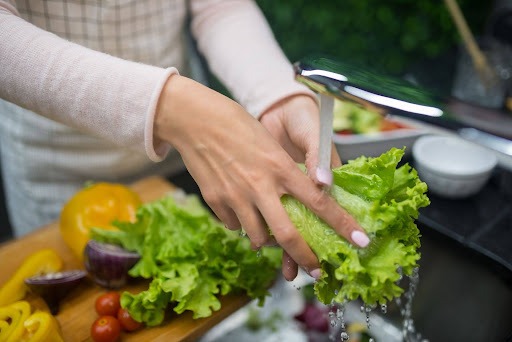
Chefs and home cooks rely on sensory signals that reflect cellular hydration, volatile compound concentration, and microbial activity, which measure the same biological realities that postharvest researchers track instrumentally. For leafy greens, turgor is the primary metric. Crisp, firm leaves with no sliminess at cut edges signal intact cellular water content.
A wilted leaf has lost water through transpiration, and while a brief cold-water soak can restore some crispness, it cannot reverse the underlying structural decline. Aroma serves as the most reliable early signal for stone fruit and berries. Fragrance loss typically precedes visible decline because the volatile aromatic compounds responsible for flavor dissipate as cellular integrity breaks down.
Root vegetables reveal their age through weight relative to size, since a carrot or beet that feels unexpectedly light has lost moisture through respiration during storage. Soft spots or surface shriveling confirm that late-stage moisture loss. Building a relationship with a local supplier often reduces the farm-to-table timeline, giving these sensory indicators a stronger starting baseline.
| Pro Tip: Use sensory signals rooted in cell biology: crisp turgor in greens, aroma in stone fruit, and weight in root vegetables. Ask suppliers for harvest date, not just delivery date. |
The Bottom Line
The gap between harvest date and consumption remains a permanent feature of modern food logistics. Scale, geography, and perishability force supply chains to manage produce actively at every stage. Agronomists time their harvests based on transit windows, while cold-chain specialists track temperatures across thousands of miles to prevent premature senescence.
Safety protocols require equal precision behind the scenes, so food-safety scientists rely on standardized workflows and specialized sample preparation supplies to extract and identify residues accurately. Every step, from field cooling to traceability logging and lab analysis, exists because quality and safety degrade naturally over time. Understanding the biological countdown of fresh produce allows for better storage decisions and more realistic expectations in the kitchen.