


Mushrooms are popping up and rooting into Austin culture, moving from forest floors to farmers’ markets, restaurant menus, and high-tech warehouses across Texas.
The Rise of Hi-Fi Mycology
Hi-Fi Mycology is a small-scale, urban farm that has steadily expanded since 2017. The operation sprouted from the two founders’ combined passion for foraging and science, and grew into two warehouses with multiple staff.
“It feels really good [to see it now from where it came from], since the markets are always changing and with everything going on, it’s tough to take time to look at how far you’ve come, but when you do do that, it’s like ‘Oh damn’,” the owner Sean Henry said. “I remember the stress of not being able to grow mushrooms for longer than three weeks [when we first started].”
Henry co-founded Hi-Fi Mycology with his business partner Cory Nellissen in 2017. He was originally introduced to the use of technology and science to grow products while he was in the hydroponic lettuce business. Henry’s love for foraging also played a part in diving into the world of mushrooms.
“Hydroponics was a science and tech way of farming, and mushrooms are super similar to that because you have to take control of the environment,” he said. “Mushrooms are also just super cool; they have a magnetic attraction. I like to forage a lot and started learning about them, which got me interested.”

Mushroom Magic: From Oysters to Lion’s Mane
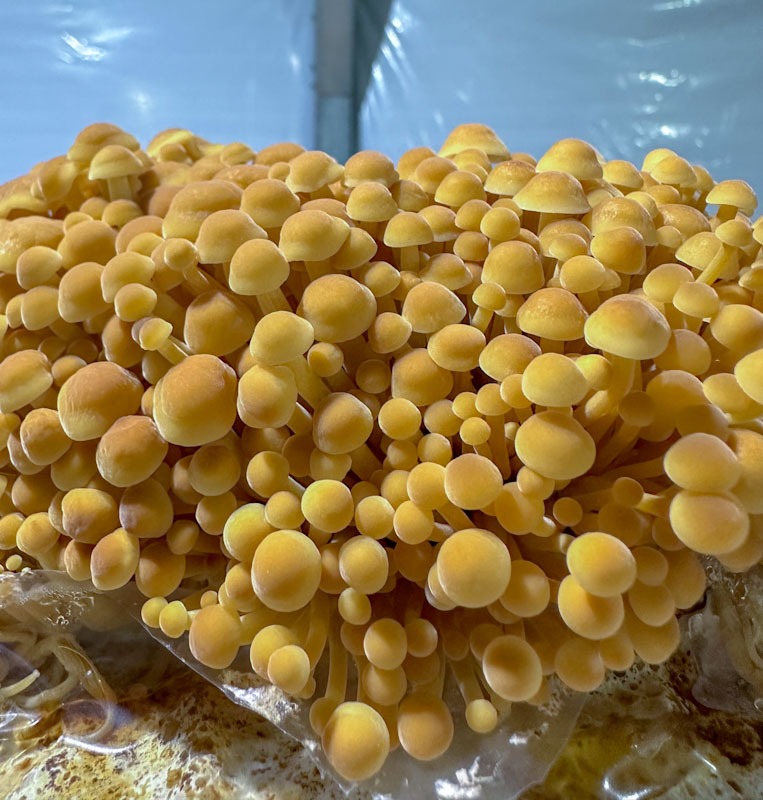
Hi-Fi grows all kinds of magnetic mushrooms, some of them even take over animals like a type of zombie mushroom. This magical world can be found in their fruiting room, where mycelium has exploded into beautiful mushrooms seemingly straight from nature documentaries.
Walking in feels like emerging in a botanical rave – dewy, colorful, and surreal. The blooms pop out of plastic bags and reach out to visitors, welcoming them into the mystical chamber.
All kinds of colors and shapes take the form of oyster, pioppino, chestnut, lion’s mane, and reishi mushrooms.
Blue oysters are a favorite among the team because the stems are softer compared to other mushrooms, creating a more pleasant culinary experience. Lion’s mane is popular, though, because of the anecdotal research backing it has.
“We should be adding mushrooms to more things, and if you can eat them, we should be having one serving a day,” Henry said. “You have to experiment for yourself and see what is best for your body because everyone is different.”
The zombie mushrooms are called cordyceps, and those use an animal host to survive instead of dead plant material like the other varieties Hi-Fi grows. They are mostly used for medicinal products, but Henry thinks there is potential for these mycelia to break into the food market.
He jokes that they have to be careful not to become patient zero from the popular show “The Last of Us”. Henry said his social media posts about the “zombie mushrooms” get a lot of engagement as a result of the show.
“The world of mushroom farming is cool because there is a massive citizen science component. There is so much experimentation that has gone on to be able to do this stuff. It’s wild,” he said.
Thankfully, a zombie apocalypse isn’t happening at Hi-Fi. The cordyceps are given a nutrient-dense food that doesn’t require animal products.
The team has had to adapt to an oscillating mushroom market and experiment with new varieties because there are a lot of trends and research around mushrooms, and their evolution can relate to that of the fungi’s process itself.
How Mushrooms Grow – Simplified
Hi-Fi’s first warehouse resembles a mad scientist’s lab full of petri dishes, sterile tents, and hazmat suits. Staff also work in an assembly line to prepare bags of pellets for mushroom food. All of the magic starts here with the combination of a mushroom culture and a bag of food for it to grow in.
Hi-Fi’s name was inspired by the replicating mushroom slices on the petri dishes because Hi-Fi is an audio term that refers to a copy of a copy with little to no distortion from the original. The mushroom samples are just that.
“It’s the same principle here, with every step of the way being as clean and easy as possible,” Henry said. “We spend a lot of time and energy to make sure that happens.”
The samples are added to grain bags to grow into mycelium, the vegetable part of fungi, and then split into bags of sawdust to incubate. As the mycelium grows, the bags are moved from the lab to the second warehouse.
The second warehouse is very different from the first, with rows of earthy, brown bags transforming into fluffy, white bags like storm clouds ready to burst. The wire racks fill the massive room with hundreds of those 10-pound bags, creating a mesmerizing ombré.
Compared to a mad scientist’s lab, this warehouse is a modernized, Mother Earth sanctuary.
The brown sawdust bags are new arrivals from the lab, showing only tiny white mycelium spots. The completely white bags full of mycelium are a sharp contrast. The tiny spots engulf the sawdust bags with white organic material.
The mycelium grows in stable conditions on the shelves for a few weeks before being moved into the fruiting room. The fruiting rooms are like mini greenhouses, or raves, where the team can control the environment to give the mushrooms exactly what they need to succeed.
Texas Challenges and Sustainability
Texas doesn’t make it easy to grow mushrooms in warehouses. The fruiting rooms attempt to control the environment inside the buildings as much as possible, but the fluctuating weather in Texas makes it harder.
Most mushrooms need consistency and do not do well with change. They are the friends who always want to eat at the same restaurant, sit in the usual booth, and order the same dish every time.
Some mushrooms are sensitive to the point where a few hours in too dry conditions will ruin the flowering mushrooms and make them unusable. Henry is having to constantly watch temperatures and conditions in the buildings to make sure they can give the mushrooms what they need to produce correctly.
The food source they use to grow the mushrooms from is also important in creating the perfect environment, very particular fungi. Hi-Fi uses red oak sawdust because dead wood is a necessary component to growing mycelium.
Red oak is used mainly as building materials and BBQ fuel, and these create sawdust as a byproduct. Instead of letting that go to waste, Henry uses it. He doesn’t support cutting down forests to supply this industry, but he is interested in using the byproducts as sustainably as possible. His red oak is currently coming from Missouri because he struggles to find fresh sawdust in Texas.
Beyond the Plate: Mycelium and the Environment
Medical and food industries are not the only ones interested in researching mycelium. Henry said there is a large section of researchers who are looking into how mycelium can be used in bioremediation.
“Mycelium lives in the soil and connects everything from a natural perspective. It shares nutrition and information between everything living in the soil,” Henry said. “We are really disconnected from the soil right now. We don’t realize everything comes from it and that we should be taking care of it.”
There has been success with using mycelium to clean up oil spills, purify toxins from the soil, and mitigate environmental pollution. They are small, but mighty cleaners when put to the task. The implications of this research and future findings are massive. Mushrooms can save the environment and keep it healthy.
“The way the mycelium cleans the environment is super interesting,” he said. “They do magic in the soil like digesting oil pollution, and there are thousands of different species of fungi, so who knows what each one would be able to do to clean up pollution.”

What’s Next for Hi-Fi
As for Hi-Fi, their future lies within continued growth and expansion into related products such as tinctures and others. Henry wants to maintain their current operation levels and is hiring more staff as well.
Of course, avoiding becoming animal hosts for the zombie mushrooms is a top priority as well. They want to keep “The Last of Us” as a fictional show, not a reality in the warehouse. Continued experimentation with other mushrooms is ongoing, too.
“Because of the market in Texas, fresh mushrooms are a strong leg to stand on, but Hi-Fi has to branch out into other things,” Henry said. “There’s a whole world of dubiousness when it comes to mushroom supplements, but we can produce the supplements from the mushrooms that we do grow, so you know what you are getting in every single bottle. We grew the things that are in there.”
They are currently in seven farmers’ markets and two grocery stores while working with two distributors focused on the restaurant and catering industry.
“The overall industry in Austin is growing like crazy, but growing more mushrooms right now is too expensive for us,” he said. “Since we are an urban farm, it’s not the safest place to be while paying for urban Austin industrialized rent. So, we have to look for other revenue streams and continue branching out.”